

Recent research by the Rights and Resources Initiative demonstrated that the DRC’s first REDD+ initiatives in Mai-Ndombe province do not adequately respect the rights of local peoples. What is more, they are actually failing to protect their forests.

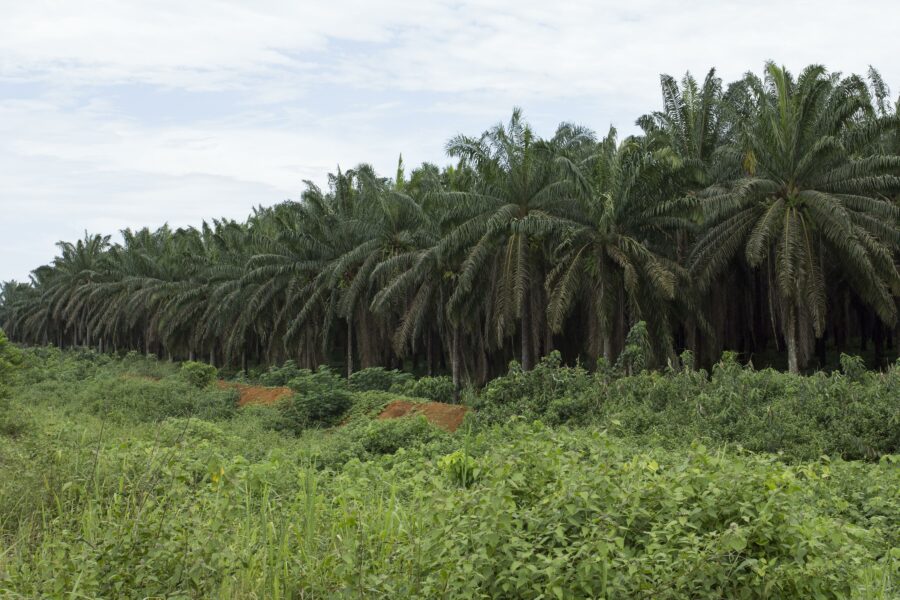
Civil society organizations and communities affected by oil palm concessions across Liberia have grouped themselves in addressing urgent issues in the oil palm sector, demanding more access to mechanisms that can make concessionaires more accountable in line with laws and regulations.
Land rights is emerging as a big issue in the UN’s REDD+ programme to reduce deforestation, with concern focused on a tract of 9.8 million forested hectares in the Mai-Ndombe province in the Democratic Republic of the Congo (DRC).
The forests of Mai-Ndombe (“black water” in Lingala) are rich in rare and precious woods (red wood, black wood, blue wood, tola, kambala, lifake, among others). It is also home to about 7,500 bonobos, an endangered primate and the closest cousin to humans of all species, sharing 98 percent of our genes, according to the WWF.
The forests constitute a vital platform providing livelihoods for some 73,000 indigenous individuals, mostly Batwa (Pygmies), who live here alongside the province’s 1.8 million population, many of whom with no secure land rights.

In a new study released today, researchers say they have identified significant flaws in ambitious forest preservation projects underway in a densely-forested region of the Democratic Republic of the Congo (DRC), where a decision on future investment by the World Bank’s Forest Carbon Partnership Facility (FCPF) is imminent. The DRC province of Mai-Ndombe has been a testing ground for international climate schemes designed to halt forest destruction while benefiting indigenous and other local peoples who depend on forests for their food and incomes, with US$90 million already dispersed or committed for climate finance in the province.

A new analysis of the Democratic Republic of Congo’s Mai-Ndombe province finds REDD+ investments in the region are moving forward without clear recognition of the land rights of Indigenous Peoples and local communities. The findings come at a crucial time, as a decision on future investment by the World Bank’s Forest Carbon Partnership Facility is imminent.
Given that the 1989-2003 civil wars were in part driven by disputes over land and resources, observers are worried what the future holds as a UN peacekeeping mission prepares to leave Liberia in March.

We asked six experts about the biggest opportunities, moments, and potential catalysts for change they see for community land rights in 2018. Here’s what they had to say.

There is a real need for community forestry to contribute to reducing emissions while securing immediate community benefits such as livelihoods diversification, climate change adaptation, and employment. These benefits can only become a reality if community tenure, and not simply access and benefits, is secured.

Indigenous and community organizations often find that progressive laws on land tenure do not always translate into progress on the ground. Even in the Democratic Republic of Congo (DRC), where forestry laws allow for community ownership and management of land, there are major obstacles hindering the realization of customary forestry rights.

For many governments, upholding commitments to demarcate and recognize community lands is both vitally important and no small task—particularly in environments where land commissions face constrained funding, political or economic roadblocks, or other obstacles. After a number of representatives from land commissions in Africa voiced a desire to exchange experiences and learning with their colleagues from across the continent, we joined forces with the African Union’s Land Policy Initiative to hold a three-day workshop in Accra, Ghana.
Over the last two decades, companies in search of vast tracts of available land for agriculture, mining, and other uses have increasingly turned to rural Asia and Africa. From 2008 to 2010, between 51 and 63 million hectares of land were acquired on the African continent through such large-scale land acquisitions (LSLAs). And while the repercussions of LSLAs affect entire communities, women suffer the most.

Women living in forest communities play a crucial role in climate change mitigation and economic development in low- and middle-income countries.

In Liberia, the promise of Africa’s first female president has fallen short: across the country, community and rural women have been cut off from the decision-making processes that affect them. Many are losing the lands and resources they rely on.
Ghana’s forests and the people who depend on them face an illegal logging and mining epidemic.

Community advocates in Brazil, Guatemala, Kenya, Taiwan, and 21 other countries call on governments, private sector to recognise that secure land rights are vital to the global struggle against climate change

Amid last year’s political shocks and challenges to the primacy of human rights, one consistent and inspiring global trend emerges: the growing recognition that the land rights of Indigenous Peoples and local communities are key to ensuring peace and prosperity.
Forced evictions are at the heart of most African land disputes, and local anger over those displacements threatens investment across the continent, a report said…
New research released on Thursday by the Rights and Resources Institute shows that despite improvements in respect for communities’ rights by global companies, land rights remain largely ignored.
Forced evictions of local communities from their lands by foreign companies fuel around two-thirds of land ownership disputes across Africa.

Experts at Dakar event point to a significant cause of investment losses, work stoppages and violence across Africa: the failure of governments and companies to respect the land rights of indigenous and local communities
Mr. Alfred Brownell, a campaigner for the land rights of Liberia’s local communities, and his staff at Green Advocates have gone underground after threats from the police. This is the latest in a long history of threats, intimidation, and harassment against human rights defenders in Liberia.
Since the 2000s, sub-Saharan countries–in efforts to meet the requirements of the Bretton Woods institutions, particularly the World Bank–have developed Poverty Reduction Strategy Papers (PRSPs),…
A new RRI analysis reveals that secure tenure for Indigenous Peoples and local communities—a key climate change mitigation strategy—is notably absent from the Paris Agreement…